Damage and fines, settled down to the last penny
A collision, damaged goods, a fine from abroad or an incident note — every event has its own register, a cost in the fleet analysis and, if the company so decides, a deduction from the driver's pay.
In a haulage company, damage and fines come from all directions: a driver phones after a scrape in a car park, a consignee reports damp goods, and three weeks later a letter arrives from a foreign authority with a registration number and a date that tell you nothing. intelit.ai handles these matters in three linked registers — damage, fines and incident notes — so that every amount lands in the costs of the right truck and any recharge to the driver is calculated once and visible in their pay settlement.
The registers do not replace a loss adjuster, a law firm or the accounts department. They organise what the company has to do anyway: collect the documents, establish who was driving, report the damage to the insurer, pay or appeal the fine and decide whether the cost is borne by the company or the driver. Every decision stays in the history with the name of the person who made it.
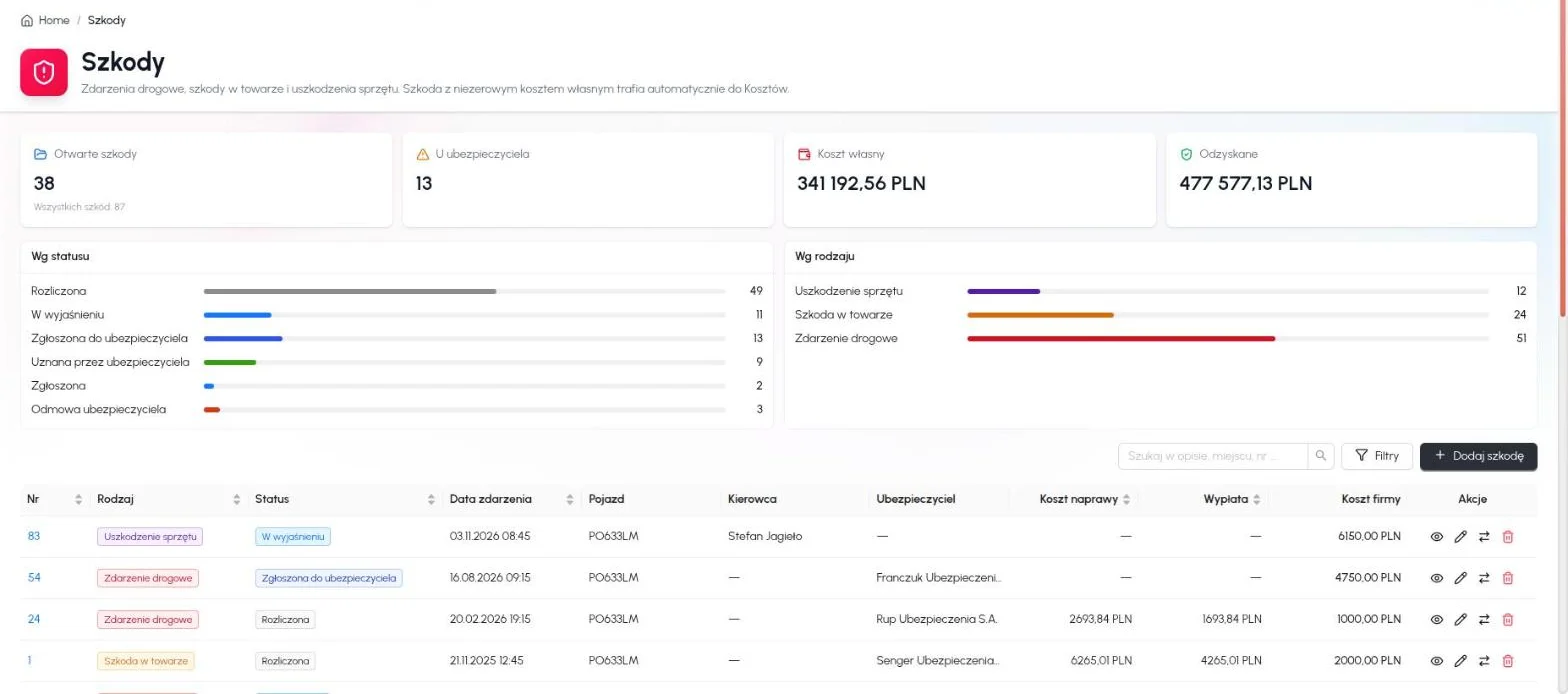
Damage register: road, cargo and equipment
Every damage case is one of three types: a road incident, cargo damage or equipment damage. The form shows the fields relevant to the type — for a road incident the distinction between a collision and an accident with injured parties, the other party's details, their insurer and policy number, police attendance and the report number; for cargo damage a description of the load, the type of damage and the claimant; for equipment the name of the damaged item.
Each case is linked to a vehicle, a trailer — or both, since one collision often damages both — a driver, an order and a team. It has a date and place, a country, a liability finding and typed attachments: photos, damage report, police report, insurer documents, invoice or estimate, and CMR. A damage case can also be opened straight from a vehicle handover report, with the truck, driver and the report's findings already filled in.
- collisions and accidents with the other party's details and police report
- cargo damage: shortage, breakage, damp, temperature breach, theft, contamination
- damage to equipment and fittings
- photos and documents assigned to an attachment type
Damage workflow through to settlement with the insurer
The status of a damage case changes only through a status-change action, following a fixed transition table: reported, under investigation, reported to insurer, accepted or rejected by insurer, settled or cancelled. Not every case goes to the insurer — the company covers broken straps itself, so such a case can be settled straight away. The status history records who moved the case, when, and what they added, which matters when a dispute over a rejection has to be reconstructed months later.
In the insurer field the system suggests the vehicle's policies that were valid on the day of the incident. Nothing is filled in automatically, even when there is only one policy, because whether the claim goes under own-damage cover, the carrier's liability (OCP) policy or the at-fault party's motor liability depends on liability and the type of damage, and a form cannot decide that. Clicking a suggestion does, however, fill in the insurer, policy number and insurance type in one go.
What a damage case really costs the company
The own cost of a damage case is the repair cost — or, until that is known, the estimated value — minus the insurer's payout, never below zero. The policy excess is recorded for information and not counted a second time, because it is already reflected in the difference between repair and payout. If the repair has a workshop job, its cost is not entered on the damage case, so it is not counted twice.
Every damage case has a mirror cost that feeds into the vehicle and fleet cost analysis. Tiles above the list show the number of cases by status and type, along with own cost, repair cost, insurer payouts and driver recharges, without adding different currencies into one figure. The damage report by driver converts amounts into euros at the NBP (National Bank of Poland) rate for the day before the incident and — when mileage has been calculated for the whole period — gives a rate per hundred thousand kilometres.
Fines: who was driving on the day of the offence
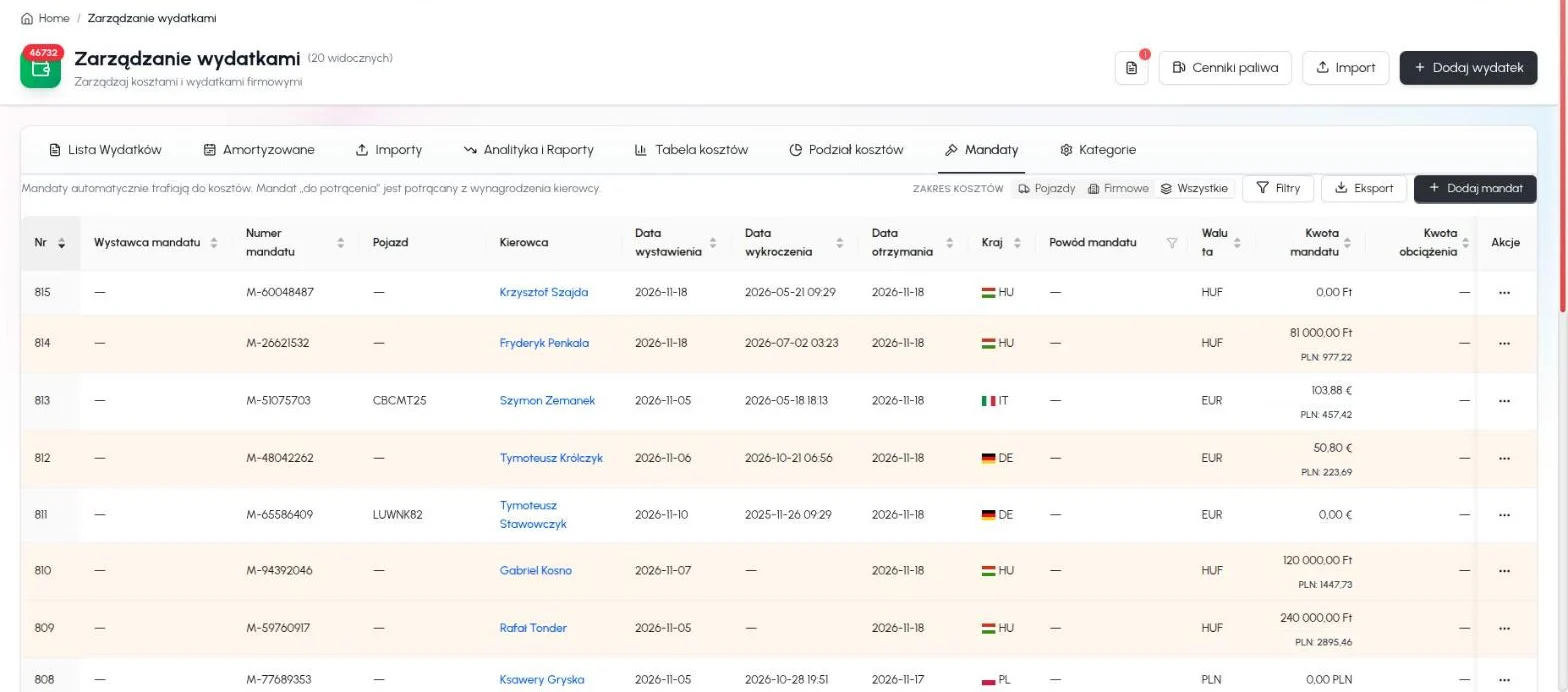
A fine records the issuing authority — ITD (Poland's road transport inspectorate), police, customs, another inspectorate or a foreign authority — the decision number, the dates of the offence, issue and receipt of the letter, the payment deadline, amount and currency, country, penalty points, reason and legal article. Recurring reasons are saved by the company as ready-made phrases. A scan of the fine is added as an attachment, including by pasting a screenshot from the clipboard.
What takes longest with a fine is working out who was driving. Once the vehicle and offence date are on the form, a list appears below of the orders that truck was running around that date, with drivers taken from the order crew, trailer and truck swaps or the rota — those whose transport window covers the moment of the offence first. This is a read-only preview: a person picks the driver. For hired tractor units that are not in the fleet, the registration number is added by hand and reused for later fines.
- suggested orders and drivers for that truck on the day of the offence
- warning about a duplicate fine number
- “needs clarifying” flag and confirmation that the driver was informed
- filters by offence date, issue date, driver, vehicle and country
Driver recharges and paying the fine
For each fine the company decides who bears the cost: the company or the driver. If it is the driver, the amount goes into their pay settlement as a deduction, while the company's cost and the recovered amount are recorded in two separate places, so nothing is counted twice. A debit note to the driver can be issued for the fine, with currency converted at the NBP rate for the day before the letter was received and an optional surcharge, and the payment document for the fine can be recorded.
For damage cases the driver recharge works differently, because it is usually a negotiated share of the cost rather than the full amount — entering an amount is itself the switch that creates the deduction. Cancelling a damage case reverses both its cost and the pay deduction, and for a fine, switching the charge from the driver to the company removes the deduction. Whether and how much may be deducted from pay depends on the driver's contract and the law; the system calculates and documents, but it does not replace that judgement.
Incident notes with cost and employee recharge
Not every event is damage or a fine. Lost keys, a broken company phone, a late arrival that cost the company a penalty from the customer — matters like these are described in an incident note. It has a number in a monthly series, a date, a person — a driver or an office employee — optionally a vehicle and trailer, a subject, description, photos and files, the cost of the event and the amount recharged to the employee. The note is printed for signature.
For a driver, the recharge goes into pay as the item “Deduction – incident note”. For an office employee, the amount is only recorded on the note and settled in their salary outside the system. Notes are never deleted: a cancelled note stays in the history with the reason and the person, and the recharge disappears from pay. The change history shows every state of the note before and after each edit.
Frequently asked questions
Does the system read the details from a fine by itself?
No. An office employee enters the fine details and attaches the scan. The system helps with the hardest step — it shows the orders and drivers that were using that truck around the offence date — but a person picks the driver.
How does the system work out who was driving on the day of the offence?
From the orders that vehicle was running around the offence date, including trailer and truck swaps, and from the order crew or the driver rota. Orders whose transport window covers the moment of the offence are shown first.
Can a fine be recharged to the driver automatically?
Only when the driver has been chosen to bear the fine. The amount then goes into their pay settlement as a deduction, and a debit note can also be issued. By default the company bears the cost.
How is the own cost of a damage case calculated?
The repair cost, or the estimated value until that is known, minus the insurer's payout, never below zero. The excess is recorded for information, and any driver recharge is settled separately in their pay.
Does the system report the damage to the insurer?
No. The company reports the damage, and records in the system the insurer's claim number, the dates of notification and decision, the amount claimed and paid, and the reason for any rejection. The system also suggests the vehicle's policies valid on the day of the incident.
Do damage and fines go into vehicle costs?
Yes. Every damage case and every fine has a mirror cost that feeds the vehicle and fleet cost analysis for the period in which the event took place.
What about fines for hired trucks that are not in the fleet?
The registration number of such a tractor unit is added by hand with the first fine and selected for later ones. The vehicle does not appear in planning or on orders.
How is an incident note different from a damage case?
A note describes an event involving a specific person — a driver or an office employee — with a cost and a recharge. A damage case follows a workflow with the insurer and concerns a vehicle, cargo or equipment.
Keep damage and fines in one place
We will show you the damage register with its insurer workflow, the driver suggestion on a fine and the deduction in the driver's pay settlement.
Book a demo