Job profitability and costs
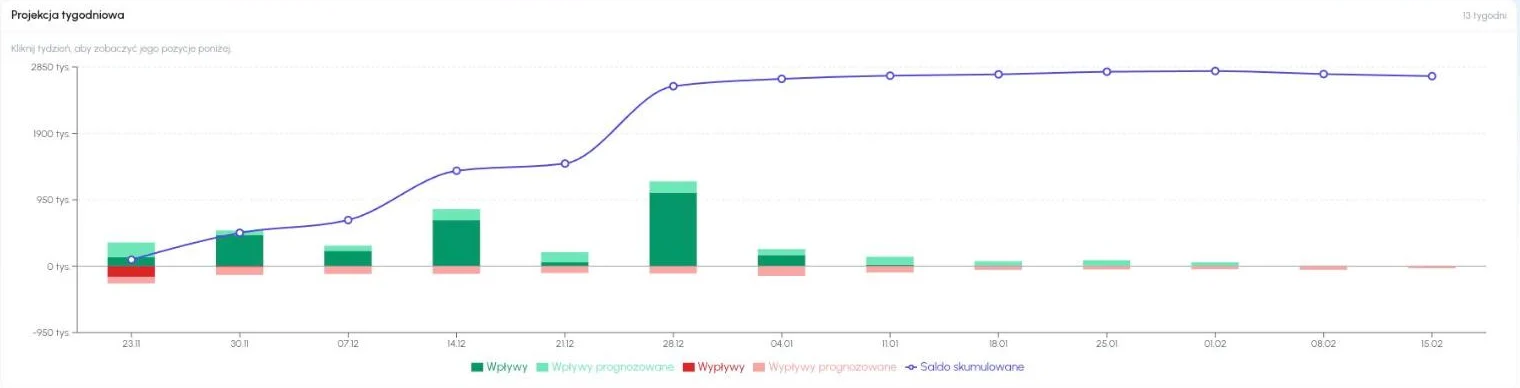
A haulage company can have a good year and still lose money on half its lanes. You only see the difference when profit is calculated per job.
The annual profit and loss account tells you how much the company earned. It does not tell you what it earned it on. That distinction sounds academic until it turns out that twenty per cent of lanes are being subsidised by the rest and nobody noticed, because over the year the totals balanced out.
Profit has to be calculated at the smallest unit that makes commercial sense, which means the individual job. Only the sum of those results, grouped by customer, lane or vehicle, tells you something you can base a decision on.
Direct costs: easy, because they come with a document
Road tolls, ferries, parking, the subcontractor's invoice, extra services on the order: these items can be assigned to a job without any interpretation, because each has its own document and its own date. Collecting them is a matter of discipline, not methodology.
That is exactly why most companies calculate profitability on these costs alone. The result comes out optimistic and systematically overstated, because it leaves out everything that did not arrive on an invoice marked with an order number.
- road tolls, ferries, parking and extra services recorded on the order
- the carrier's invoice checked against the agreed rate
- corrections and surcharges added after delivery, not forgotten
Indirect costs: where the real work begins
Fuel, driver pay, leasing, servicing, insurance, office costs: none of it arrives labelled "order no. 4471". These costs have to be allocated, and the allocation method determines whether the result means anything at all.
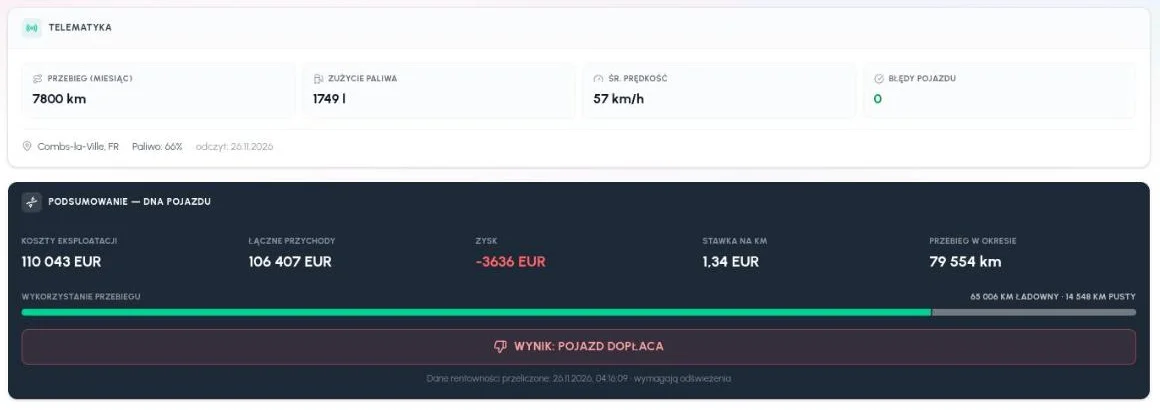
For an own fleet, the fairest method is allocation through the vehicle: the cost of running the combination is divided by its mileage over the period, then assigned to jobs in proportion to kilometres. Simple, repeatable and resistant to creative accounting.
We deliberately do not load everything in. Administrative costs can be spread across jobs, but then the result on a job stops answering the operational question "was this load worth taking?" and starts answering a different one. It pays to keep the two levels apart.
Cost per vehicle kilometre, not cost per kilometre
The distinction is not pedantry. In Poland, "cost per kilometre" usually refers to the kilometrówka, a flat mileage allowance for cars used in tax settlements, which is something else entirely. What a haulage company cares about is the cost of driving one kilometre with a specific vehicle combination, including everything that combination costs.
It is calculated from data that comes in anyway: fuel card transactions, road tolls, workshop invoices, lease instalments and driver settlements. The system collects them against the vehicle and divides them by kilometres driven, loaded and empty separately.
That last point changes the picture the most. A combination with fifteen per cent empty running has a different real cost per loaded kilometre from an identical combination running thirty per cent empty, even though both look similar in the annual summary.
Time: the cost nobody invoices
A job that takes two days instead of one costs twice as much driver time and blocks the truck from the next load. In a calculation based on fuel and the rate, that difference does not exist, because nobody issues an invoice for a lost day.
When drivers' working days are assigned to jobs, the cost of time enters the result. Lanes with an excellent rate per kilometre where trucks wait at the loading bay for half a day can then come out worse than dull routes at a lower rate.
Customer profitability is not the sum of job profitability
A customer who provides plenty of loads at a decent margin but pays after ninety days and generates three complaints a quarter can be less profitable than a smaller customer who pays on time.
That is why the per-customer view covers not only the result on jobs but also the actual payment term and how much money the company has tied up with that customer. Only on that basis can you have a conversation about raising rates or ending the relationship.
Why bother, if the market sets the rates?
Because knowing your own break-even point changes the way you negotiate. Without it, turning down a load is a hunch and accepting one is wishful thinking. With it, you know the rate below which a job makes no sense even with an idle truck in the yard, and that is the only figure that genuinely protects your margin.
The second reason is simpler: every month you have to decide where to send the trucks. A ranking of vehicles and lanes based on data takes a minute; one based on impressions takes all of Monday and ends in an argument.
Frequently asked questions
How do you calculate the margin on a job?
The job's result divided by its revenue. For a job handed to a carrier, the cost is their invoice plus any additional costs; for a job run with your own truck, it is direct costs plus the allocated share of vehicle and driver costs.
Is the result visible before the job is completed?
Yes, based on the agreed rate and the costs known when the order is accepted. It updates as invoices and corrections come in, so the provisional and final results can differ, which is useful, because it shows where the calculation drifts from reality.
What about jobs settled in different currencies?
Selling in euros and buying in zloty is the norm, not the exception. We show the result in the order currency when it is uniform, and when it is mixed, with an explicit exchange rate, so the currency difference is not hidden inside the margin.
Where does the system get mileage for the cost per vehicle kilometre?
From telematics if it is connected, otherwise from the order route or manual entry. The better the source, the smaller the gap between kilometres settled and kilometres actually driven.
Can administrative costs be allocated to jobs?
They can, but we do not do it by default. The operating result on a job and the company result after overheads answer different questions, and mixing them blurs both.
How do you treat empty running?
As a separate item against the vehicle, not as an add-on to the next job. That way you can see what the empty leg to a pickup costs, instead of that information being lost in the cost of the job.
Can I build reports without knowing the system?
The core profitability views are ready-made and need no configuration. Less common breakdowns can be described in plain words; the system generates the report on demand by aggregating your transport data.
Let's calculate the result for your month
We take one month of your jobs and show which lanes and vehicles come out differently from how they seem.
Book a demo