Driver settlements
The most labour-intensive task of the month in a haulage company, and the one most likely to end in a dispute with an employee.
Settling an international driver's pay rarely fails for lack of know-how. It fails on data collection. Information about where the driver was and how long they worked is scattered across the tachograph, the transport plan, the planner's notes and the driver's own memory. Pulling it together into one table takes several days, and the result is still often disputed.
Intelit.ai approaches this from the sources. Since routes, working days and border crossings are already in the system, the settlement should follow from them, not be built alongside them in a spreadsheet.
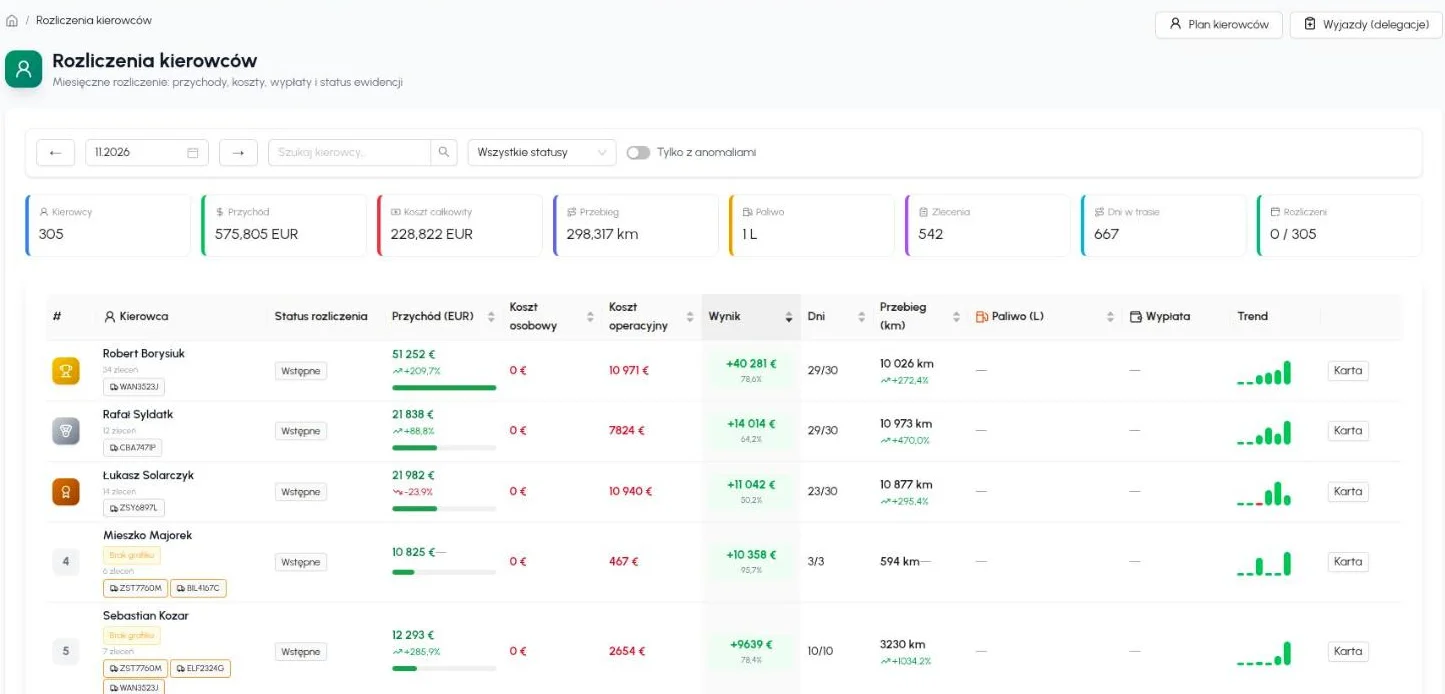
What makes up a driver's pay
A driver's earnings in international transport are almost never a single figure. They consist of the contractual element, components that depend on work abroad, and sometimes bonuses for mileage or for a claims-free record. On top of that come the rules on the posting of workers, which vary depending on the country and the type of transport.
The settlement model is set by the company together with its accounting and HR teams; the system does not impose one. What it does supply is the input data: where the driver was, for how many days, in what capacity and on which job.
- working days at home and abroad, broken down by country
- days assigned to specific jobs and vehicles
- fixed and variable components shown separately
Where the working-day data comes from
The basis is what the tachograph recorded and what follows from the vehicle's position. Where the sources complement each other, the more complete one wins: if telematics shows a border crossing and the tachograph has no record for that day, the gap is flagged for clarification instead of quietly dropping out of the summary.
Gaps are sometimes unavoidable: a forgotten card, a device failure, driving someone else's vehicle. The system's job is not to pretend they do not exist, but to show them in one place before the settlement goes to payroll.
Drivers can see their own settlement
The biggest source of disputes is not the rate itself but the lack of visibility. The driver learns the result after the fact and has no way to check it, so the only route to verification is a conversation with HR.
When the summary of days and routes is visible in the app as the month goes on, discrepancies surface during the month rather than after payday. That reduces the number of disputes more than any change to the pay policy.
Consistency, or why a spreadsheet is not enough
A settlement spreadsheet usually starts out working well, then breaks down as exceptions pile up: a different driver, a different contract, a different country, a different rate from a certain date. After a year, nobody but its author knows why the formula in that column looks the way it does.
Rules recorded in the system have two advantages: they apply to everyone equally, and they leave a trail when they change. In an inspection or a dispute, the question is not "what was the total?" but "on what basis?", and a spreadsheet usually cannot answer that.
Closing the month in hours instead of days
The practical measure of success is simple: how long it takes to prepare the full set of settlements, from month end to handing the data over to HR. In companies doing it by hand, it typically takes one person three to five working days, spread across the first week of the month and interrupted by calls from drivers.
When data flows in continuously, the work shifts from "collecting" to "checking exceptions". You are left with a dozen or so items that need a decision instead of several hundred that need retyping, and that is the whole difference: decisions cannot be automated, and retyping is not worth doing by hand.
The link to job cost
Driver pay is one of the largest components of transport cost, and at the same time the one least often included in the costing of an individual job. As a result, profitability is calculated on fuel and the rate, and labour cost only shows up in the annual figures.
When the driver's days are assigned to jobs, labour cost can be allocated to orders. That changes the picture for lanes where the rates are decent but the job takes twice as long.
Frequently asked questions
Does the system calculate pay and replace payroll software?
It does not replace it. It prepares the input data for the settlement (days, countries, routes, mileage) and makes it available in a form that can be passed to HR or to an accounting firm. Calculating and paying wages stays with the HR and payroll system.
Are international drivers treated as being on a business trip?
Polish regulations in this area have changed, and the approach used previously no longer applies across the board. Classification and the settlement model are decisions for the company and its adviser, which is why the system does not impose one option but supplies the data each of them relies on.
What if a driver used several vehicles?
Days are assigned to the driver, not the vehicle, so a change of truck during the period does not break up the summary. At the same time, the vehicle keeps a record of who drove it on a given day.
How does the system handle double-manned crews?
A job can have two drivers assigned, and days are counted separately for each of them. Without this, settling a crew requires manual adjustments that are easy to miss.
Do you need access to tachograph files?
The more complete the sources, the fewer manual additions. We agree the scope of available data during implementation: some companies get it from telematics, others from a separate system for downloading driver cards.
Does the driver need an account to see their settlement?
Yes, the view is available in the driver app. Companies that prefer not to share it can switch it off, but then they lose the main benefit, which is catching discrepancies earlier.
Can I settle self-employed drivers?
Yes. The summary of days and routes is the same; what changes is the final document. Instead of payroll data, it produces the basis for an invoice from the contractor.
See a settlement built on one month of data
We take one month of a chosen driver's work and show where every line of the summary comes from in the system.
Book a demo