Transport planning
A planner running a dozen or more trucks makes dozens of decisions a day. Most of them come down to checking whether something will fit.
Planning in a haulage company rarely looks like optimisation. It looks like a puzzle solved against the clock: a call comes in with a load, a quick check of which truck is free, whether the driver has enough hours left, whether the trailer suits the goods, and a decision made in three minutes, because in a moment someone else will take the load.
A planning tool only makes sense if it works at that pace. A plan that needs ten minutes of data entry will lose to a sheet of paper and a good memory every single time.
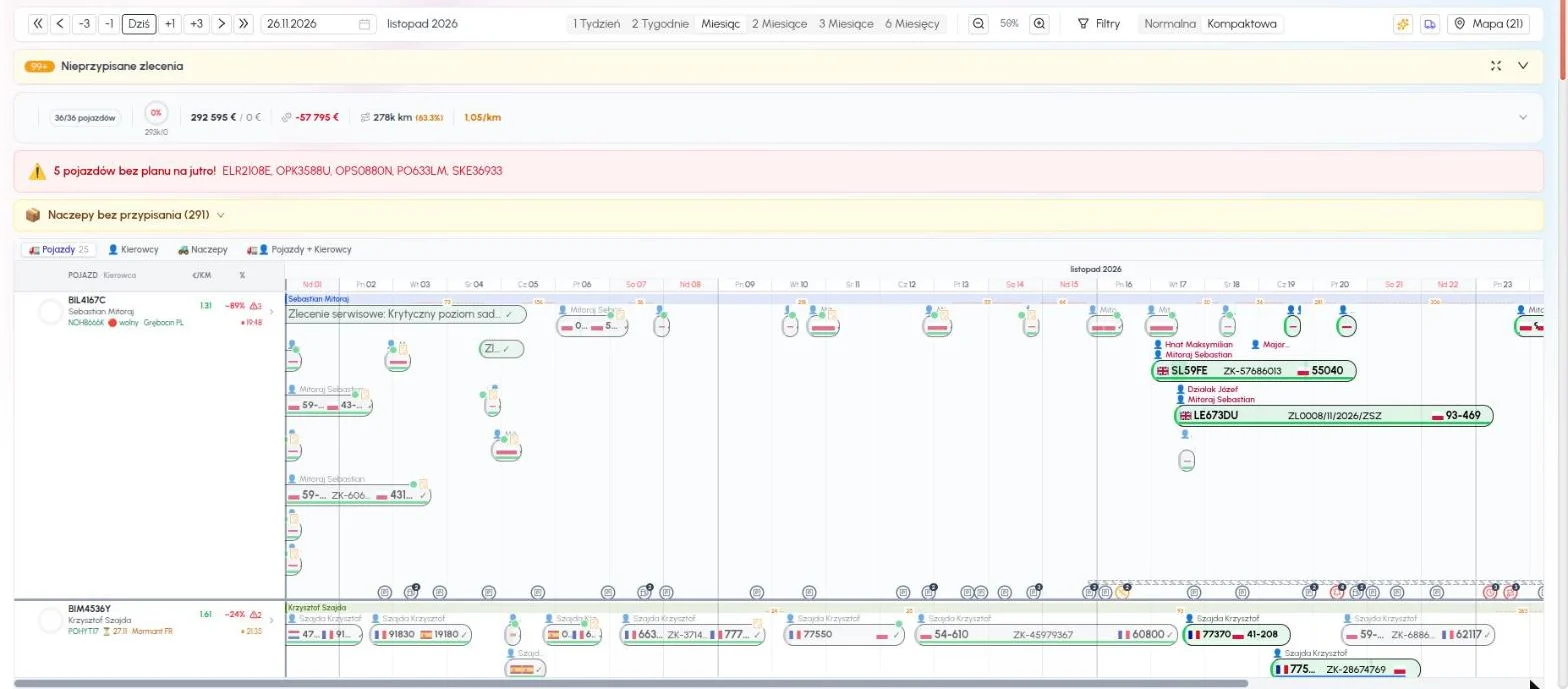
A calendar that shows what is already booked
The foundation is a view with vehicles and drivers in rows and time running horizontally. A job moves between resources by drag and drop, and overlapping dates are highlighted immediately instead of coming to light on the day of collection.
A conflict is not just two jobs at the same time. It is also a truck in the workshop, a driver on holiday, a trailer coupled somewhere else, and a job that simply cannot be completed within the driving time available.
- vehicles, drivers and trailers as separate resources, each planned independently
- overlapping dates and unavailability visible straight away
- moving a job to another truck without breaking its history
Driver working time as a hard constraint
A plan that ignores the EU rules on driving times and rest periods is a plan only until the first roadside check or the first missed rest. The planner usually knows this, but checking takes time they do not have.
That is why the driver's remaining driving time is visible at the moment a job is assigned, not in a report a month later. The question "will they make it?" stops being a matter of gut feeling.
It works both ways, too: planners sometimes turn down a load out of caution, even though the driver had hours to spare. Knowing the real position increases the number of accepted orders just as often as it prevents impossible ones.
Load parameters and vehicle constraints
Payload, height, a reefer requirement, ADR, the required number of pallet spaces: these are conditions that are either met or the job cannot go ahead. Checking them by hand is exactly the kind of work that is not worth repeating dozens of times a day.
The system matches the order's requirements against the parameters of the vehicle combination and flags a mismatch before assignment, not when the driver is already standing at the loading bay.
The Planning Agent: a proposal, not a decision
An AI agent looks for matches between available trucks and loads, whether from freight exchanges, booked orders or your own network of partners, and suggests options together with the reasoning behind each pairing.
It is a proposal on purpose. The planner knows things that are in no database: that this driver does not want to run that lane, that unloading at this consignee always takes longer, that this customer needs handling differently from what the spreadsheet suggests. A system that dispatched trucks on its own would be flying blind in this industry.
Empty running visible at the planning stage
The empty leg to a pickup has no invoice of its own, which is why it is rarely counted when the decision is made. Yet it is often what separates two offers at a similar rate.
When the proposed assignment shows the empty kilometres to the pickup, the choice between a better-paid load from a distant collection point and a cheaper one close by stops being a matter of intuition.
The plan survives until the first phone call, and that is normal
A load slips, the warehouse refuses delivery, the driver gets a puncture, the customer cancels two hours before collection. In transport, a change of plan is not a process failure; it is the process itself, and a tool should be judged by how well it copes with replanning, not by how the initial plan looks.
So moving a job to another truck is a single action, and its consequences, such as a new arrival time, a change in the driver's workload or a clash with the next order, appear immediately. A calendar where every change means correcting five things in five places is abandoned within a week, and the paper comes back.
What the planning module will not do
It will not find loads that do not exist. In a weak market no tool will fill a fleet; what it will do is improve utilisation of what is available and cut the time it takes to put a plan together.
Nor will it replace talking to the driver. A plan is a hypothesis about the future and regularly drifts away from it; the value of the tool lies in how quickly the plan can be reworked, not in how good it looked on Monday morning.
Frequently asked questions
Does the system plan on its own or make suggestions?
It makes suggestions. The Planning Agent proposes matches and explains them, but a person approves the assignment. In transport, too much important information does not exist in any database.
How does the system know how much driving time a driver has left?
From the driver activity data collected in the system: tachograph records and telematics data. We agree the range of sources during implementation, as it depends on what the company already has.
Can I plan jobs subcontracted to carriers?
Yes. A job can be assigned to your own vehicle or to a carrier; in the latter case planning covers dates and documents rather than resources, because those are not under your control.
Can the plan be shared with drivers?
Drivers see their jobs in the app, with details and documents. Any change to the plan is visible to them straight away, which cuts down on clarification calls.
Does the module optimise the driving route?
Planning is about assigning loads to resources and time slots, not about plotting the road route. Route and distance are calculated for costing and for comparing options.
How many vehicles do I need for this to make sense?
The threshold depends more on the number of simultaneous jobs than on the number of trucks. With a handful of vehicles a planner remembers everything; with a dozen or more, mistakes start creeping in, and that is when the calendar starts paying for itself.
Does planning work for both domestic and international transport?
For both. The difference lies mainly in working-time constraints and paperwork, not in the mechanics of building the plan.
Let's plan your typical week
In the demo we take a real week of your jobs and lay it out in the calendar, including the conflicts that usually only surface in practice.
Book a demo