Conversations with drivers right on the order
Your company WhatsApp Business number connected to the system: the message goes out from the order, and the reply and the photo of the document come back to the same place.
Most of what you know about a job is not created in the system but in conversation. A driver writes that he is queuing at the dock, a carrier sends a photo of a signed CMR, a dispatcher asks for the trailer number. These exchanges decide whether an order is settled on time — and for years they took place on private phones, outside any kind of record.
Connecting a company WhatsApp Business number to the system does not change drivers' habits, because they are already there. What it changes is where the conversation ends up: on the order it relates to, visible to the whole forwarding team, rather than on one person's phone.
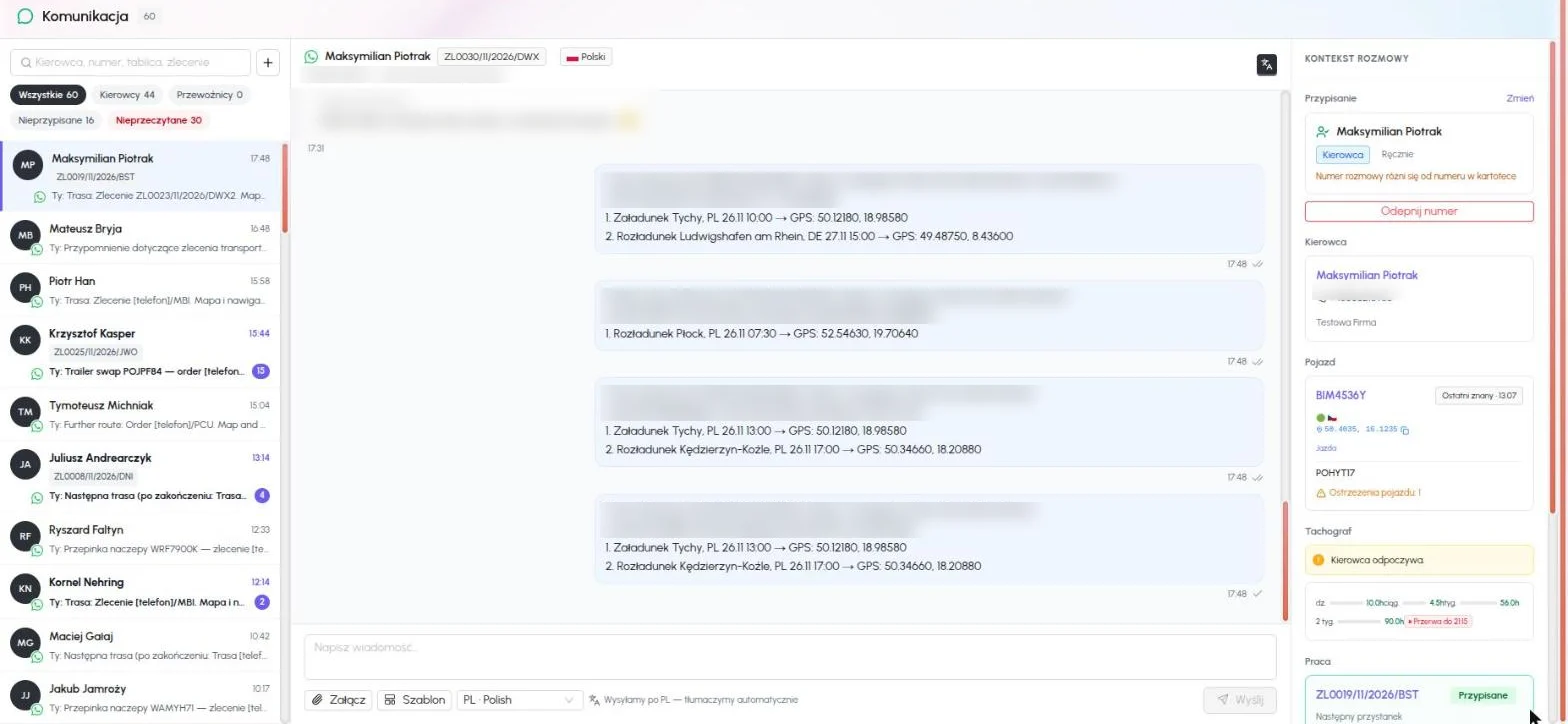
The company's number, not the planner's private phone
What gets connected to the system is a WhatsApp Business number owned by your company, not a shared number belonging to the software vendor. The sender is therefore the forwarding company the driver knows, and its name is what appears on the recipient's phone.
The practical consequence is that correspondence stays in the company. When a planner goes on holiday or changes jobs, the history of conversations with carriers does not disappear with their phone, and whoever takes over the order sees everything that was agreed.
- your own number and sender name, not the system vendor's number
- conversation history stays on the order, not on a private phone
- different companies' correspondence never ends up in a shared inbox
Messages pinned to the order
A message goes out from a specific order, and the reply comes back to the same place — with the time and the author. The dispatcher does not have to search their phone to find who confirmed the booking slot and when, because the record sits next to the job data.
The same applies to subcontracted carriers. Arrangements about truck placement, a delay or extra waiting time become part of the order documentation, rather than a verbal story that has to be reconstructed during a claim.
Photos of documents instead of an envelope
The most common attachment is not text but a photo: a signed consignment note, a fuel receipt, a damaged pallet on the dock. A photo sent in the conversation goes into the order files, so the person preparing the invoice does not have to wait for the originals to see whether delivery was made without reservations.
This does not replace the paper trail — originals still travel to the office where the customer requires them. What it does is shorten the time between delivery and the moment the company knows it can issue the invoice.
Drivers write in their own language
The thread is kept per phone number rather than per order — exactly as it looks on the driver's phone. Next to the conversation the system shows which job it currently relates to, so the dispatcher has the context and the driver does not need to start every message with an order number.
The second thing is language. A message arriving in Ukrainian, Romanian or Hungarian is translated into the language the forwarding office works in, and the reply goes back to the driver in his own language. That usually decides whether a question about the unloading time is understood first time, or after three attempts and a call to a colleague who translates.
- conversation pinned to the number, with the active order shown
- two-way translation: Polish, English, Ukrainian, Russian, Romanian
- plus Bulgarian, German, Czech, Slovak and Hungarian
The 24-hour window and templates — a limit you cannot get round
WhatsApp is not a channel where you can write to anyone at any time. A free-form message can only be sent within 24 hours of the recipient's last message. Outside that window, any message initiated by the company requires a template approved in advance by the channel operator.
That is why notifications sent from the system — a reminder about a missing document, a nudge about a task — use approved templates, while the conversation itself then flows freely. It is worth knowing before implementation, because this is a rule of the channel, not a limitation of the software.
- free-form reply: within 24 hours of the recipient's last message
- company-initiated message outside that window: approved template only
- templates are reviewed by the channel operator
Driver numbers and consent
A driver's phone number, or that of a carrier's contact person, is personal data and is treated as such: the company running the correspondence remains the data controller, and Intelit processes the data on its instructions. This is described in our privacy policy.
For the same reason, the channel is suited to matters related to carrying out the job, not to sales messages. A driver who is asked about the unloading time replies; the same driver will block a number that sends him an offer.
When WhatsApp is not the right channel
A damage claim, a payment demand and anything that might end up in court should go by e-mail or letter — not because a chat is less credible, but because the counterparty and the insurer expect a different format. The system sends these documents by e-mail, and that is how it stays.
WhatsApp, on the other hand, is the fastest way to find out where a truck is standing and why. This distinction is worth making at the start of implementation, because trying to move all correspondence into a single channel ends with some matters getting lost.
Frequently asked questions
Do I need a separate phone number?
Yes. A number connected to WhatsApp Business is assigned to the company and cannot be used at the same time in the ordinary WhatsApp app on someone's phone. In practice companies dedicate one forwarding office number to it.
Does the driver have to install anything?
No. On the driver's side it is the ordinary WhatsApp he already uses. All the change happens on the company's side: the message goes out from the system and comes back to the order.
Can the whole team see all the correspondence?
Conversations are visible to the people working on the company account, just like the order documents. That is intentional: cover for a colleague or handing over an order should not mean losing what was agreed.
Can I message a driver first?
Yes, but outside the 24-hour window after his last message it has to be an approved template. We prepare templates during implementation for typical situations: a missing document, a change to a booking slot, a task reminder.
What about carriers who do not use WhatsApp?
Nothing changes for them. Orders, documents and reminders reach them by e-mail, and the WhatsApp channel is an extra for those who reply faster there.
Where is the content of conversations stored?
In the system, together with the order it relates to, on the same infrastructure as the rest of the company's data. One company's correspondence is never combined with another's and is not used for marketing purposes.
See what a conversation on the order looks like
We will show you how the company number is connected, how messages are sent from the order and what happens to a photo of a document sent in by a driver.
Book a demo