An AI load agent for your empty trucks
The agent looks for loads and backhauls that fit each truck's plan, talks to the shipper, negotiates the rate within your range and hands you a ready proposal to decide on.
The AI load agent in intelit.ai is built for hauliers and forwarders running their own fleet. Its job is the same as that of a planner who sits on the freight exchange from first thing in the morning: find a profitable load for every free truck, and then a backhaul so the truck does not come home empty. The difference is that the agent scans offers non-stop, for all trucks at once, and every time it checks whether the load fits the truck's plan, the driver's working time and the route.
The agent does not make commercial decisions on the company's behalf. It searches, filters, writes to the shipper, negotiates within limits set by the company and vets the counterparty. At the end the planner gets a “To decide” list sorted by truck: this load, this rate, this shipper, this is what the truck's day looks like if you accept — accept or reject.
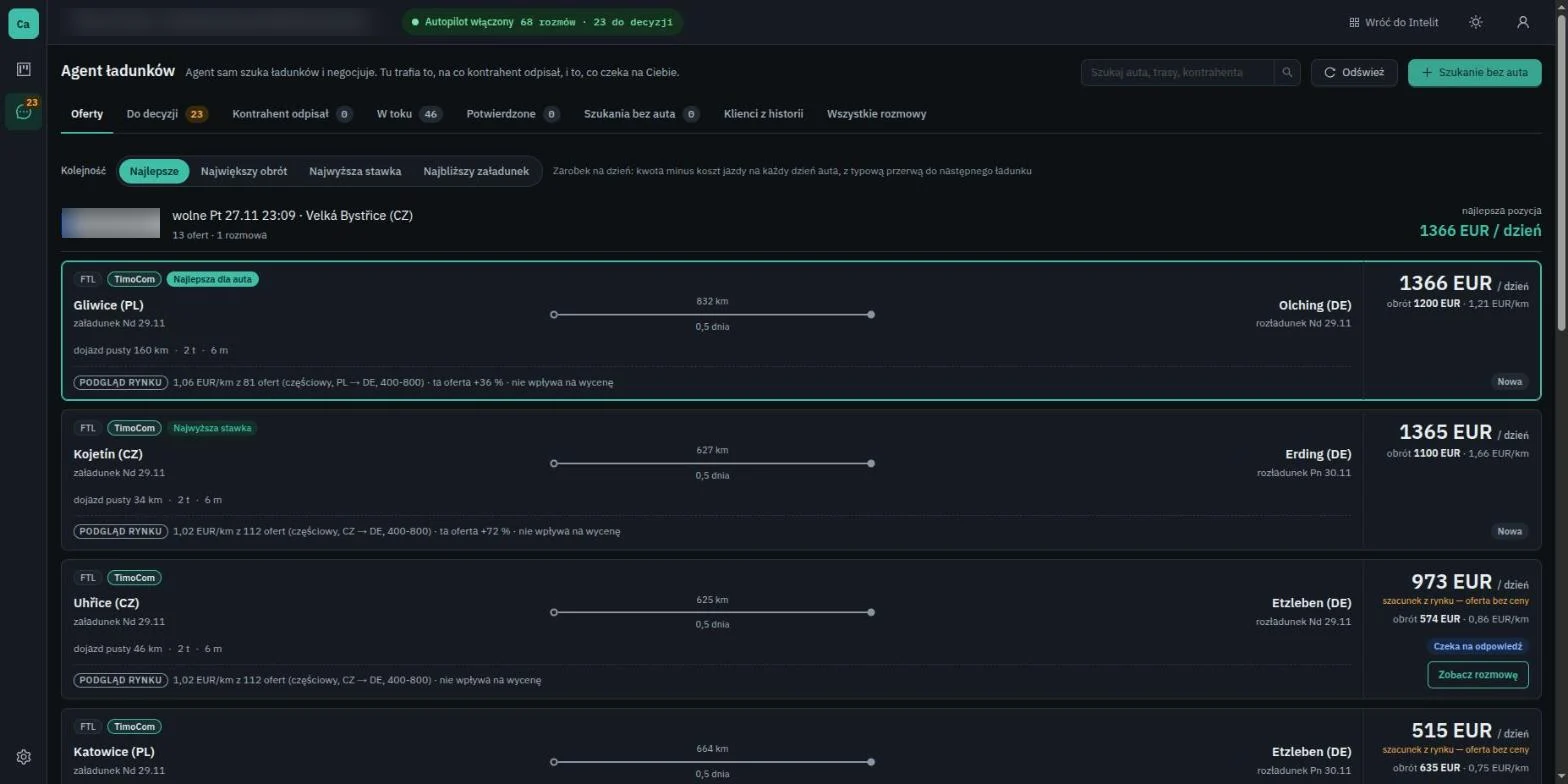
The truck's plan, not a single offer
The most common mistake when looking for loads is judging an offer in isolation from the truck. A load from Lyon to Milan looks good until you add the empty run from wherever the truck finishes unloading, the driver's break, and the fact that on a Friday evening France restricts HGV traffic. The agent starts from the truck's plan: where and when it will be free, how much working time the driver has left, whether it is heading back to base.
For a truck described this way it looks for loads that can be chained forward onto that plan — first a load from the delivery point, then the next one, all the way back home. Empty running, the loaded leg and tolls are calculated from truck routes rather than straight-line distance, so the per-kilometre rate on the proposal includes the empty kilometres too.
- starts from the place and time the truck becomes free
- driver working time and breaks built into the day plan
- truck routing and tolls instead of straight-line distance
- subsequent loads chained forward until the truck is back home
Freight exchanges and past customers
The agent scans the freight exchanges the company is integrated with, such as TimoCom and Trans.eu, as well as loads from its own network. The second source is customers the company has already worked with. When a truck will be free in a region where a regular shipper is based, the agent can write to tell them a truck is available — in the customer's language, by e-mail or on WhatsApp.
This second route is often worth more than the exchange, because a load from a known customer does not need vetting again and the rate is not being bid against dozens of other hauliers. The agent also keeps an eye on the pace of outreach and does not write to the same customer again until the agreed interval has passed.
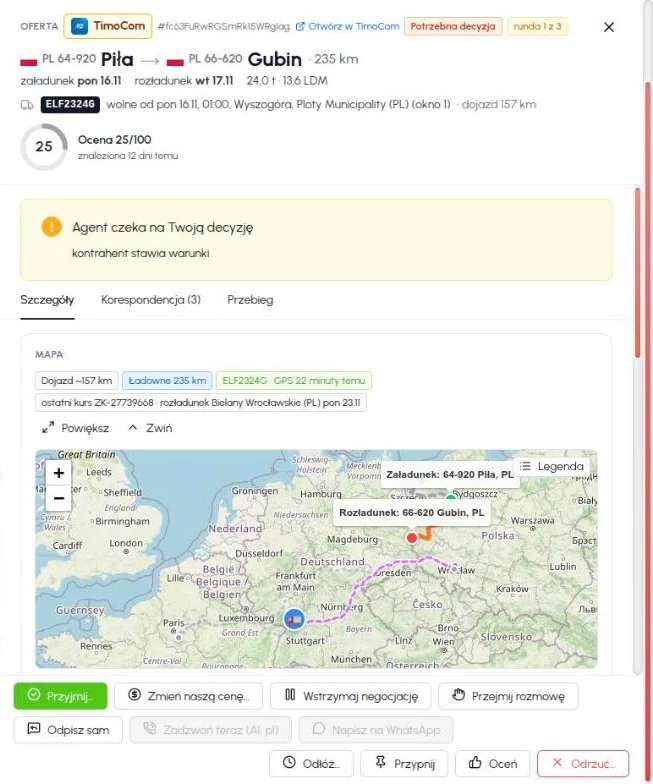
Negotiation within your range
When the agent finds a suitable load, it opens a conversation with the shipper — in the exchange chat, by e-mail or on WhatsApp, depending on where the offer appeared. It asks for missing details, quotes a rate and responds to counter-offers. The company sets the boundaries: a minimum rate per lane, a maximum empty run, the types of goods it will not carry.
The tone of each message is matched to the channel — an exchange chat reads differently from an e-mail, and both differ from WhatsApp — and to the other party's language. When the conversation goes outside the agreed range, or the shipper asks to speak to a person, the agent hands it over to the planner with full context instead of improvising.
- minimum rate and maximum empty run set by the company
- message tone matched to the channel and the other party's language
- handover to the planner outside the range or on request
Vetting the shipper before you decide
A negotiated rate means nothing if the shipper does not pay. Before a proposal reaches the list for decision, the agent checks the counterparty: the VAT number in VIES and company registers, whether the business is active and, with the business intelligence module, a report compiled from public sources. The result is shown next to the rate, and a risky counterparty requires the planner to confirm consciously when accepting.
It is the same verification the company uses for its regular orders, so a counterparty checked once is not checked from scratch for every offer, and the payment history held in the system is taken into account.
A “To decide” list instead of a pipeline board
The planner does not need to track which stage each conversation has reached. They see a list sorted by truck: for every free truck the best proposals with the negotiated rate, the counterparty check result and a preview of what the truck's day will look like after acceptance. The decision is one click — accept or reject — and an accepted load becomes an order in the system.
The company can also steer the agent with the kind of instructions every dispatcher knows: “this truck goes back to base on Friday”, “no Italy this week”, “look for reefer loads to the Netherlands”. The agent applies them to subsequent searches rather than requiring a change of settings.
How we test the agent's quality
Exchange listings and messages from shippers are free text: abbreviations, postcodes without town names, “1 trailer”, “33 Stellplätze”, a mix of languages. A language model reads them, but the code checks the numbers and places — the model has to point to the fragment it took the weight or date from, and if that fragment does not say so, the reading is rejected.
Every change to the agent goes through a reference set of cases built from real listings and conversations, plus negotiation scenarios. A change that breaks cases that used to pass does not reach production.
Frequently asked questions
Which freight exchanges does the AI load agent use?
The exchanges integrated with the system, including TimoCom and Trans.eu, using the company's own accounts. A second source is loads from its own network and customers the company has worked with before.
Does the agent accept loads on its own?
No. The agent searches, negotiates and vets the counterparty, while accepting a load remains the planner's decision on the “To decide” list. The company sets the range within which the agent may move during a conversation.
How does the agent set the rate?
According to the company's rules: the minimum rate per lane, the cost of the empty run and tolls calculated for a truck, and the negotiation range. Market rates serve as a reference point for the planner, not as an automatic source of figures.
Does the agent take the driver's working time into account?
Yes. The truck's plan includes the driver's working time and breaks, so the agent will not propose a load the driver cannot reach without breaking the rules.
Which languages does the agent use with shippers?
The other party's language. The truck-available message to past customers is prepared in dozens of languages, and conversations on exchanges and by e-mail are held in the language the shipper wrote in.
How does the agent vet the shipper?
The VAT number in VIES and company registers, whether the business is active and — with the business intelligence module — a report from public sources. A risky counterparty requires conscious confirmation when the load is accepted.
Is the load agent suitable for a small fleet?
Yes. Fleets gain the most where one person looks for loads for a few to a dozen or so trucks and cannot watch the exchanges all day long.
How is the load agent different from a freight exchange?
An exchange is where the offers are. The agent is the one who scans them, prices them for a specific truck, talks to the shipper and prepares the decision. It uses the exchanges but does not replace them.
See the load agent working on your trucks
We will show you a search for a free truck, a conversation with a shipper, a counterparty check and the list of proposals waiting for a decision.
Book a demo