Counterparty verification before you accept the order
A verification card for every customer and carrier: registers, documents, payment history and AI research with a source quote behind every finding.
Counterparty verification in intelit.ai is a card the system opens for every customer and carrier before the first order and renews every 90 days. The card is a list of concrete questions — is the business active, is the VAT number valid, is the bank account on the VAT white list, does the carrier hold a valid licence and carrier's liability (OCP) insurance, are there insolvency proceedings — each answered YES, NO or NO DATA, with a risk level attached to every answer.
The system finds most of the answers by itself: from government registers, from documents sent by the counterparty and from its own history of working with them. Where the registers are silent, an AI agent searches public sources — the company's website, its listing on maps, publications — and backs every finding with a quote from the source. Anything that cannot be established automatically is flagged as missing data for a person to fill in.
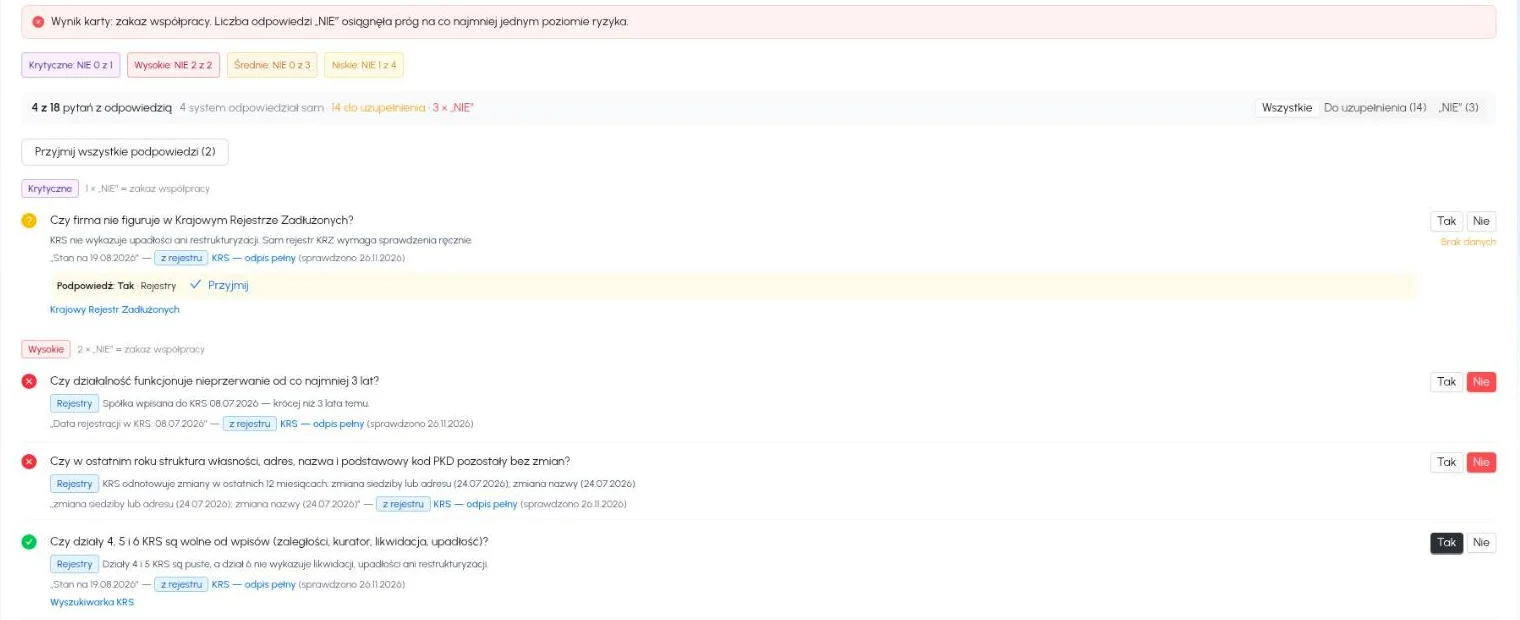
What the counterparty card checks
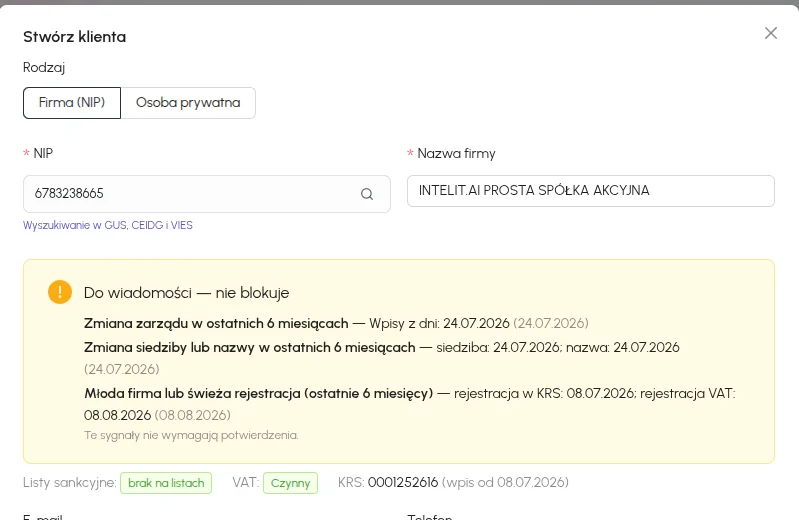
The set of questions depends on who the counterparty is. The system identifies the variant by itself: sole trader, limited company, foreign business, Polish or foreign carrier. For a company it reads the extract from KRS, Poland's National Court Register — shareholders, management board, shareholders' countries of origin, filed financial statements, changes in business activity. For a carrier, the licence and carrier's liability insurance are added.
Some questions draw on data the company already holds in the system: does the counterparty pay on time, does it have overdue invoices, have there been debit notes. No external register can provide that knowledge, and it is often the best risk signal there is.
- KRS, CEIDG (Polish register of sole traders) and GUS: business status, legal form, start date
- VIES and the Polish VAT white list: active VAT payer and registered bank account
- carrier licence and OCP carrier's liability insurance: validity, sum insured, exclusions
- insolvency proceedings, sanctions lists and personal links
- trading history: payment punctuality, arrears, debit notes
AI research with a quote behind every finding
Registers tell you that a business exists. They do not tell you whether the address is an office or a virtual mailbox, whether the website works, or whether there are warnings about the company online. That part is done by an AI agent: it looks through the company's website, checks its map listing and address, and searches for publications and posts about it.
There is one rule: a finding without a quote does not exist. The model must point to the fragment of the source it drew its conclusion from, and the code checks that the fragment really is in the source and concerns the right company. A “nothing found” answer is not treated as “all clear” — it goes onto the card as a suggestion for a person to accept.
Risk blocks the order, an authorised person decides
The card ends with a verdict. If the result exceeds the risk threshold set by the company, the order with that counterparty is blocked and the people with verification rights are notified. Only someone with that permission can release it, and they do so for a specific order — not permanently and not for everyone.
The same rule applies to customers and carriers alike. For high-value goods the system automatically adds extra questions and requires sign-off from a decision-maker before the order can proceed.
- order blocked when the risk threshold is exceeded
- release only by a person with the permission, per order
- extra questions and decision-maker sign-off for high-value goods
- card valid for 90 days, then refreshed automatically
Your own rules instead of someone else's scoring
Every transport company has its own list of things it looks at with a new counterparty: countries it will not take orders from, a minimum OCP sum insured, a required trading history. Instead of a closed “creditworthiness” score, the system provides a set of questions the company adapts to itself. The starter set is neutral, and the company's own set — with its thresholds, country list and risk levels — is loaded during implementation.
That makes the card understandable to anyone who opens it. Instead of a score of 62 out of 100, the planner sees that the carrier's policy has a lower sum insured than required and that it has been trading for four months — and knows what to do about it.
Business intelligence report
For counterparties where a lot is at stake, the system prepares an extended business intelligence report: the history of the company and its board members, related entities, financial statements, online presence and warning signs. The report is compiled from public sources and saved on the counterparty record, so colleagues do not order it again.
The same mechanism works for loads from freight exchanges. The AI load agent checks the shipper before a proposal reaches the planner and shows the result next to the negotiated rate.
Where counterparty verification pays off most
In transport the most expensive mistakes are not invoicing errors but cargo theft by a carrier impersonating someone else, and a customer who never pays for several runs. Both scenarios start with a new counterparty from a freight exchange whom nobody has worked with before, and with haste, because the truck has to be on site today.
That is why verification is built into order intake rather than parked in a separate module that someone opens “when they have time”. The card is created automatically, and the planner sees the result where the decision is made.
Frequently asked questions
Which registers does the system check when vetting a counterparty?
KRS, CEIDG and GUS for Polish businesses, VIES for EU VAT numbers, the Polish VAT white list for the bank account, plus data on insolvency proceedings and sanctions lists. For carriers, the licence and OCP carrier's liability insurance are added.
Does verification work for foreign companies?
Yes. The system recognises a foreign business and applies a separate set of questions to it. Where a foreign register is not available automatically, the AI agent looks for information in public sources, and missing data is clearly flagged.
What does the AI agent do in counterparty verification?
It looks through the company's website, its map listing and publications about it. Every finding must have a quote from the source, which the code checks before the answer goes onto the card.
Does the system block orders by itself?
Yes, when the card's result exceeds the risk threshold set by the company. Only a person with verification rights can release the order, and only for that specific order.
How often is the card refreshed?
The card is valid for 90 days. After that, the system refreshes it automatically with the next order for that counterparty.
Can I use my own list of questions and thresholds?
Yes. The starter set is neutral, and the company's own set — with its questions, list of high-risk countries and risk levels — is loaded during implementation.
Does counterparty verification replace a credit reference agency?
For everyday decisions about accepting an order, in most cases it does. For large contracts, the extended business intelligence report from the system is a good starting point, and the decision on additional security stays with the company.
Does the card take the counterparty's payment history into account?
Yes. Payment punctuality, overdue invoices and debit notes come from the company's own data in the system and form part of the card alongside the register data.
Check one of your counterparties in a demo
Give us a customer's or carrier's tax ID — we will show you the verification card, the register answers and the AI agent's findings with quotes.
Book a demo